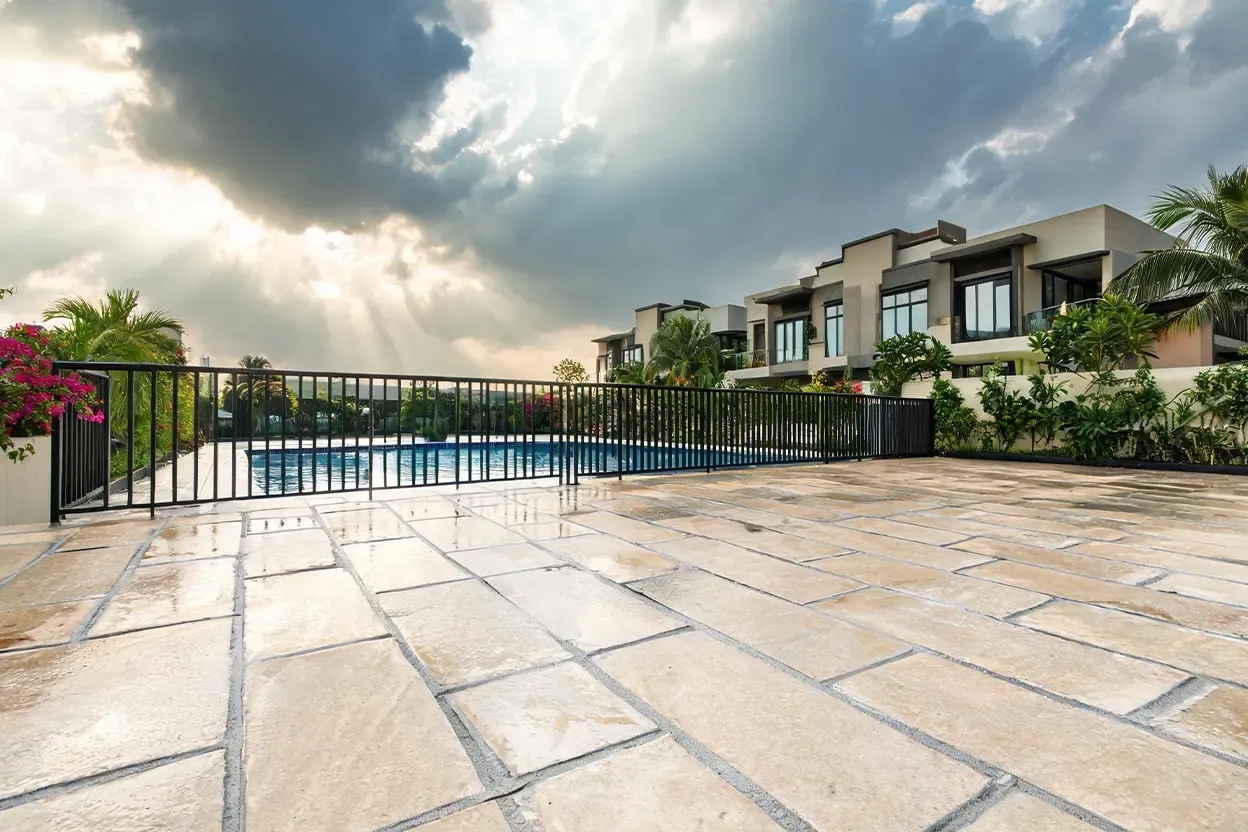
All-Weather Protection: How Modern Sanded Grout Withstands Extreme Outdoor Conditions
19 August 2026In outdoors, grout does far more than fill the gaps. On patios, balconies, facades, pool decks, and terraces, it is a working performance layer that helps hold the whole tiled surface together through monsoon rain, harsh sun, salt air, and daily temperature swings. Nature gave the gecko a grip that holds on any surface, in any weather. Modern sanded grout is built on the same idea: tighter particle packing, polymer modification, and protective additives that make it hold far longer than unsanded cement grout.
What Outdoor Grout is Up Against
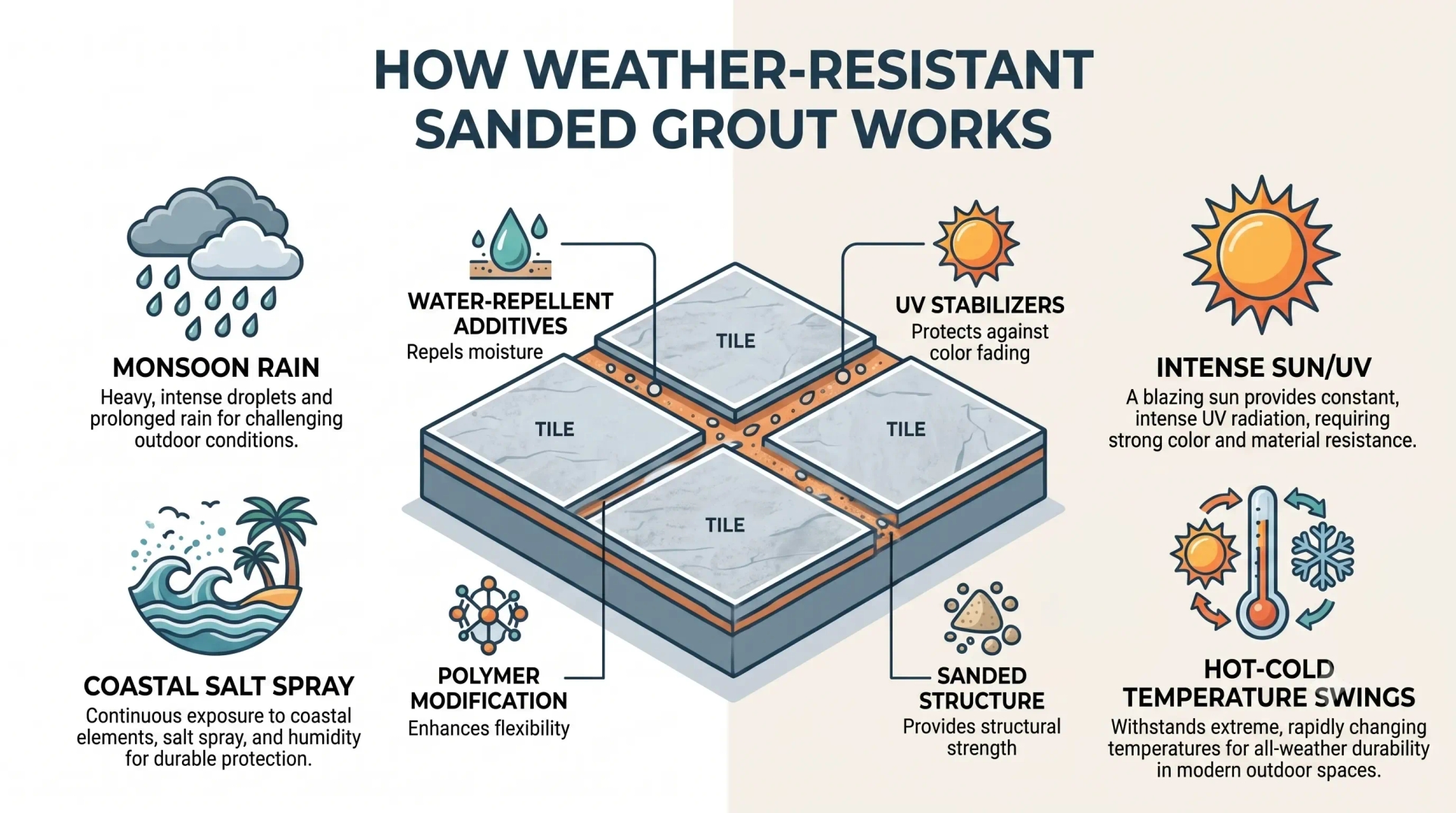
Understand the challenge and you can engineer for it. Most exterior grout wear starts with water finding its way into the joint. Once moisture sits in the joint, repeated wetting and drying gradually weakens the grout matrix, invites staining and efflorescence, and opens hairline cracks that widen over time. In India, monsoon exposure, coastal humidity, and the hot-to-cool cycling on open terraces and facades all speed this up. Most Indian cities never see true freeze-thaw, but intense daily thermal movement stresses joints in a similar way — which is exactly why the right formulation matters.
What is Modern Sanded Grout System
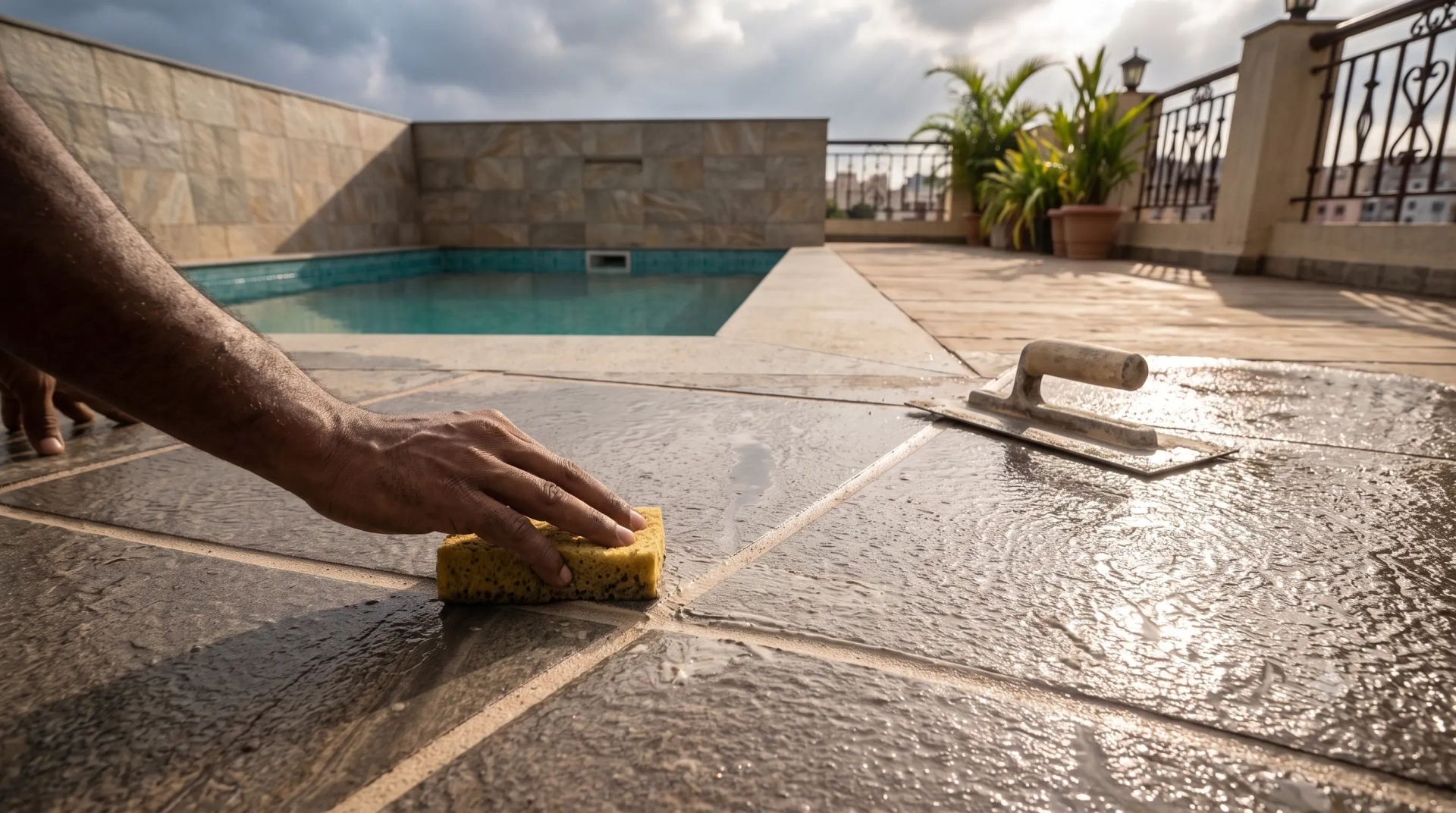
Modern sanded grout system is a cement-based sanded grout used with grout admixture. This gives the joint body and abrasion resistance; the polymers add flexibility, adhesion, and resistance to cracking under movement. In exterior areas, this system resists mould, bacterial growth, and moisture breakdown — a real advantage on shaded balconies, damp facades, and pool surrounds. The best systems go further, adding stain-repellent chemistry to the grout.
Water-repellent Technology
The biggest leap in modern sanded grout system’s performance is hydrophobic, water-repellent chemistry. Its added additives cut capillary absorption inside the grout, so water beads and sheds instead of soaking deep into the joint. In practice that means less swelling, less salt transport in coastal zones, and fewer stains from monsoon runoff — and in colder climates, less freeze-related damage. Good water-repellent formulations also shut down the hidden moisture pathways that quietly lead to debonding and tile-edge deterioration.
UV Stabilizers and Colour Retention
Direct sunlight is the other major test. UV exposure breaks down the surface chemistry of ordinary grout, causing chalking, fading, and brittle joints that crumble at the edges. UV stabilizers slow that down by protecting the polymer and pigment system from sun-driven degradation, so the grout keeps its colour and mechanical integrity for longer. That matters on Indian terraces, south-facing facades, and pool decks, where sunlight is relentless and heat reflected off the tiles piles on more stress.
Best Outdoor Applications
Outdoor patios need grout that shrugs off dirt, rain splash, furniture movement, and seasonal heat. Pool decks ask for more — constant moisture, pool chemicals, and heavy foot traffic make low absorption and stain resistance especially valuable. Building facades demand grouts that tolerate vibration, wind-driven rain, and thermal cycling without opening hairline cracks. Balconies are the sensitive ones: water can pond near drains and creep into edges, where it later shows up as cracking and leakage.
Coastal vs Dry Climates
Coastal India is a severe test. Salt-laden air works into small pores and leaves residues that encourage staining, efflorescence, and long-term surface damage, so a weather-resistant grout here has to prioritise low water absorption, chemical resistance, and strong anti-efflorescence performance. Inland and dry, the bigger challenge is repeated expansion and contraction between strong daytime heat and cooler nights, which fatigues a rigid grout line over time. One brand, every surface: coastal projects lean on moisture and salt resistance, dry-zone projects on movement tolerance and UV stability.
Freeze-thaw and Movement
True freeze-thaw damage is serious in cold climates: water in the joint freezes, expands, and breaks the grout from within. India sees little of it, but hill stations and high-altitude projects can, so exterior grout there deserves careful selection. Even in warm regions, daily thermal expansion and contraction can mimic freeze-thaw, flexing the joint every day under sun and shade. That flex is why polymer-modified sanded grout outperforms older rigid mixes outdoors — it moves with the surface instead of fighting it.
What to Specify for India
For Indian exterior work, the safe choice is a weather-resistant, polymer-modified sanded grout with grout admixture that gives hydrophobicity, UV protection, and mould resistance. Use it on terraces, balconies, outdoor steps, facades, and pool decks, where water, sun, and movement are unavoidable. On coastal projects, pair it with careful sealing and drainage to reduce salt ingress and standing water. In dry, hot zones, focus on joints that handle thermal movement and hold their colour under intense sun.
This is where a purpose-built system helps. Geco Durafill 12 is a polymer-modified sanded grout made for wider joints of up to 12 mm — sand-reinforced, weather-resistant, water-repellent, and crack-resistant, which is exactly the profile outdoor Indian projects call for. For the toughest exposures, mixing it with the Geco Durafill Max grout admixture — used in place of water — lifts adhesion, flexibility, water resistance, and colour retention while adding stain and algal resistance. Together they turn the joint into part of the weather barrier rather than its weak link.
Maintenance Matters Too
Even the best grout rewards good installation and upkeep. Fill joints fully, cure them correctly, and protect them from early water exposure so the additive system can develop as intended. On balconies and facades, inspect periodically — early cracks, open joints, or staining are far easier to fix before water gets behind the tile. Weather-resistant chemistry plus a careful install is what delivers real long-term value outdoors.
The Bottom Line
Modern sanded grout succeeds outdoors because it is engineered to meet the exact stresses Indian buildings face: monsoon water, tropical sun, coastal salt, and daily thermal movement. Get the formulation right and grout stops being the weak point — it becomes part of the weather barrier itself.