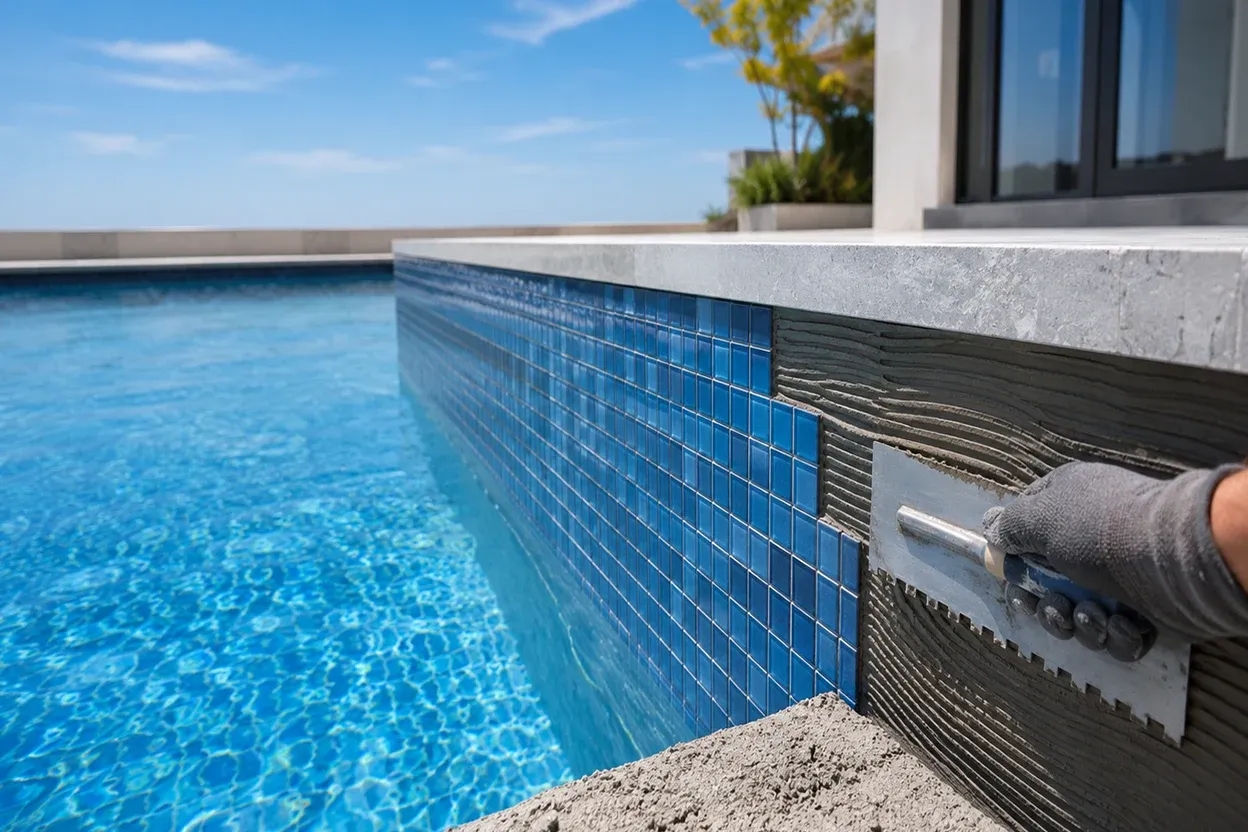
Swimming Pool & Water-Body Tile Fixing: Adhesive + Grout Guide
28 July 2026There's something quietly remarkable about how a gecko clings to a wet surface without slipping. In nature, grip is earned — not assumed. The same principle applies to pool tiling. Beneath the clean shimmer of a finished water feature lies an adhesive system doing invisible, essential work — and that system deserves the same intelligence nature has spent millions of years refining.
Swimming pools, fountains, spas, and decorative water bodies are among the most demanding tiling environments there are. Constant water contact, chlorine, cleaning chemicals, temperature changes, and structural movement all conspire against an ordinary tile fixing system. Whether you're a professional tiler specifying materials for a high-end pool project or a homeowner planning a garden water feature, the foundation you choose determines how long everything above it holds.
The combination that works: Geco Tilebond Plus for fixing the tiles and Geco Jointfill Epoxy for the joints. Tilebond Plus delivers the bond strength and coverage needed for secure, long-lasting tile fixing in submerged conditions. Jointfill Epoxy seals the joints against water ingress, staining, and chemical attack. Together, they form the invisible foundation that lets your water-body project perform as beautifully as it looks.
Why Water Is the Real Challenge
Water is patient. Given any weak joint, micro-crack, or poorly bonded tile, it will find its way in — and once it does, it gets to work. Adhesive performance weakens, grout stains and softens, tiles debond. In a swimming pool, that process is accelerated by permanent immersion or the stress of repeated wetting and drying cycles.
Chemical exposure adds another layer. Pool water typically carries chlorine and balancing chemicals that gradually degrade ordinary cementitious materials. The tile face can look fine long after the jointing material beneath it has started to fail. That's why standard tile adhesive and regular grout aren't the right specification for pool and water-body work.
Then there's movement. Pools are living structures. Temperature swings, settling, and pressure changes all stress the tiled surface. Poorly bonded tiles and porous joints give that stress somewhere to go — cracking, hollowing, detaching. Choosing the right system from the start is what keeps those forces in check.
Geco Tilebond Plus: Built for What's Below the Surface
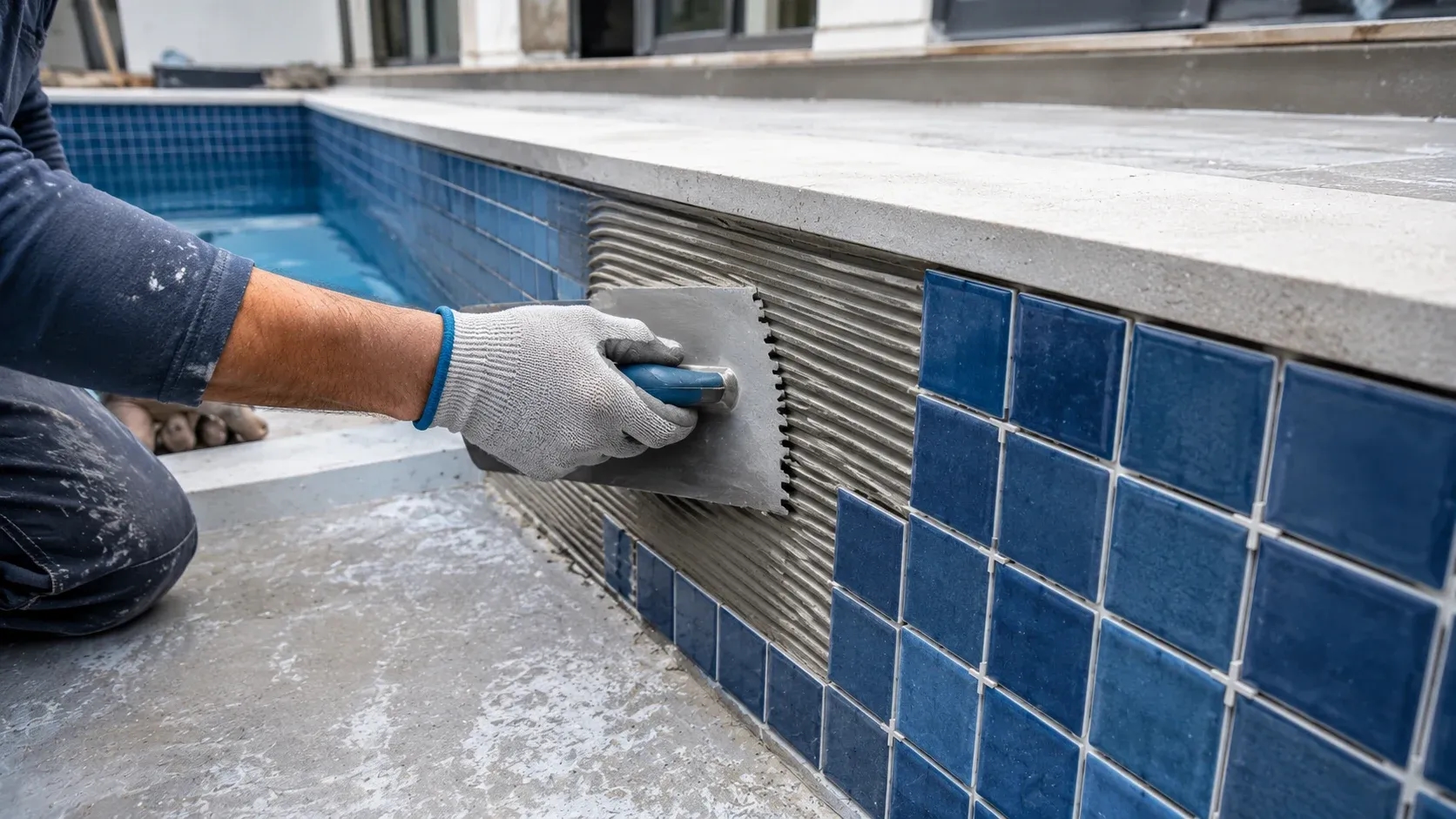
Geco Tilebond Plus is a highly polymer-modified cementitious adhesive engineered for exactly this kind of environment. In pool applications, a good adhesive doesn't just bond — it bonds consistently, without voids or weak patches behind the tile that water pressure can exploit.
- Thin-bed application: Tilebond Plus replaces the traditional thick-bed process with a cleaner, more efficient thin-bed method — faster to apply, more consistent in coverage, without sacrificing performance.
- Reduced air pockets: Its self-curing properties minimise void formation behind the tile, eliminating the structural weak points that give water and thermal movement a foothold.
- Strong wet-area bonding: The polymer modification improves adhesion in conditions where ordinary adhesives start to lose grip — exactly where pool tiling takes you.
- Improved anchoring strength: In submerged environments, the bond between tile and substrate is tested daily. Tilebond Plus is designed to hold under that constant pressure.
- Better workability: Consistent coverage is easier to achieve, which means fewer hollow spots and a more reliable installation from the first tile to the last.
These advantages translate directly into how long a tiled pool surface performs. A well-bonded adhesive bed resists water pressure, thermal cycling, and service wear — and reduces the remediation work that comes from getting it wrong the first time.
Geco Jointfill Epoxy: Joints That Don't Give In
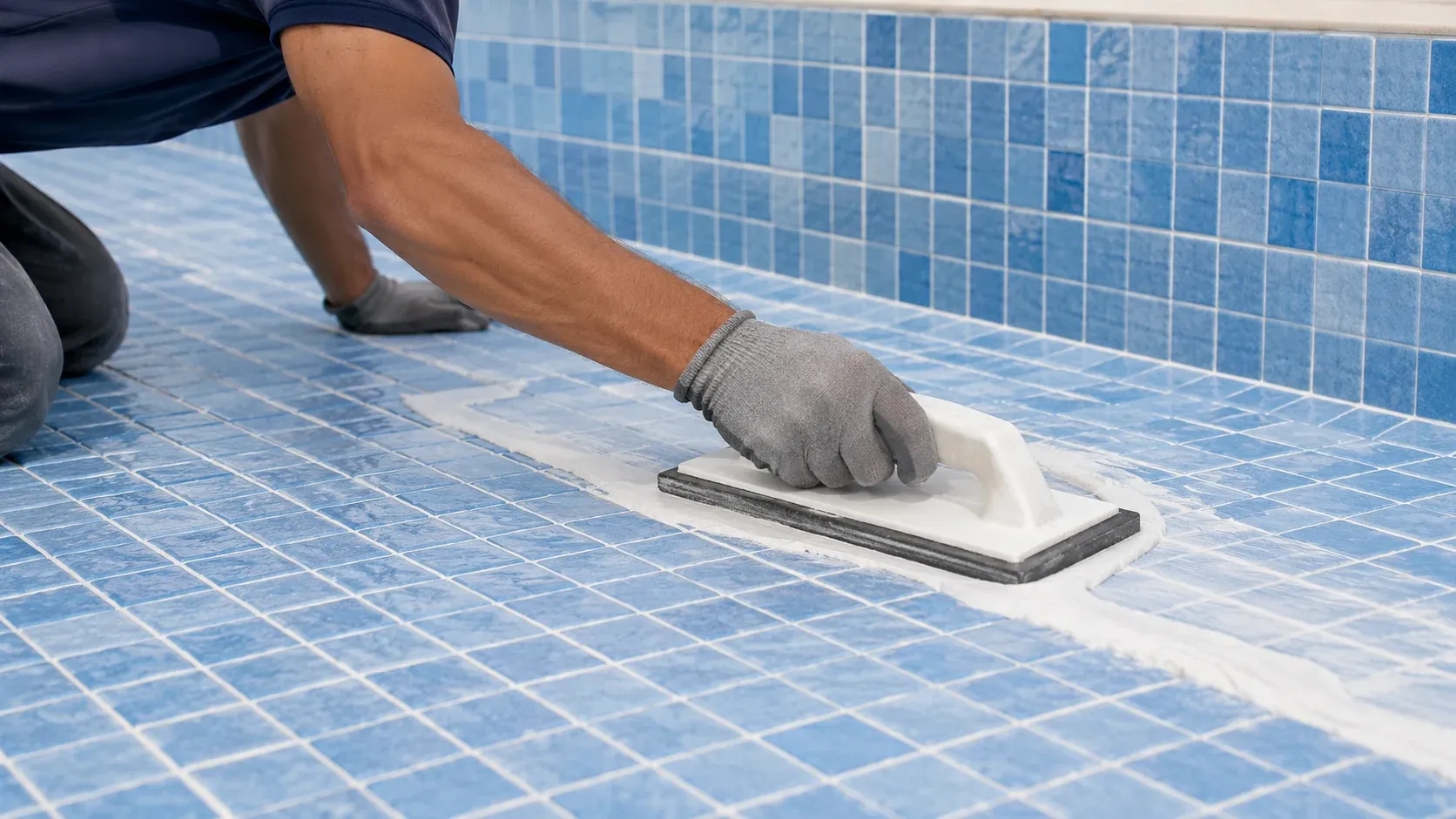
In a pool, the grout isn't decoration — it's a barrier. And Geco Jointfill Epoxy performs that role in a way ordinary cement grout simply can't match in water-exposed environments.
- Very low water absorption: Epoxy grout is far less permeable than cementitious grout, so moisture doesn't travel through properly sealed joints.
- Stain and discolouration resistance: Pool joints are in contact with chemicals, cleaning agents, and maintenance equipment constantly. Jointfill Epoxy holds its finish across years of use, not just months:
- Chemical resistance: Handles pool water chemistry — chlorine, pH-balancing agents, cleaning products — more effectively than standard grout.
- Easier maintenance: Dirt and pool residue sit on the surface rather than sinking in, so cleaning stays straightforward rather than becoming a remediation task.
- Sustained visual quality: The finish you see on installation day stays closer to the finish you see five years later.
In high-use environments like commercial pools, public water features, or wellness spas, that durability pays back quickly — fewer maintenance cycles, less discolouration, and a surface that keeps performing without extra effort.
Installation: Where Good Materials Either Work or Don't
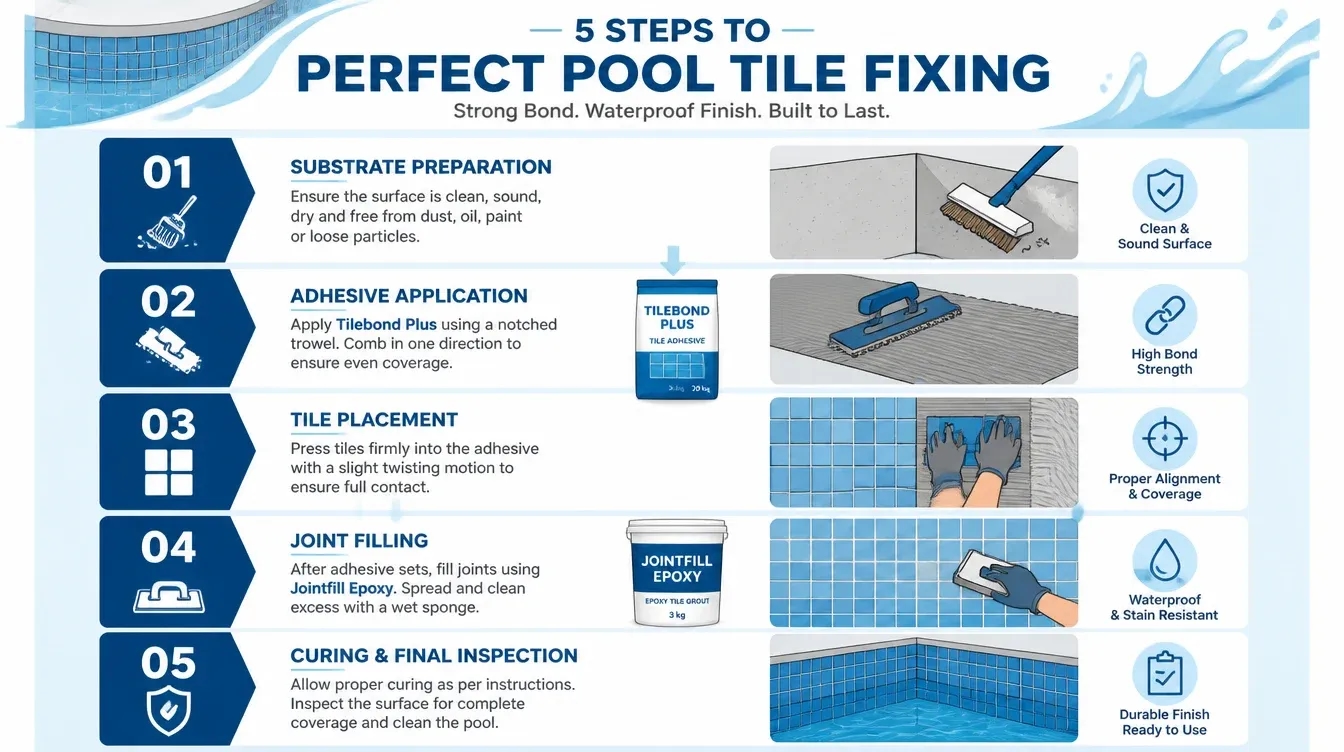
The right products can only do their job if the installation is done right. Here's what matters most:
- Waterproof the substrate: Before any adhesive goes down, the concrete or masonry surface needs a proper waterproof coating — one built for submerged conditions. Godry Maxcoat 2X is a two-component elastomeric coating with excellent resistance to water permeability and chloride ion diffusion, making it well suited for pool and water-body substrates. It bridges hairline cracks, bonds strongly to cementitious surfaces, and gives the tile system a solid, protected base to sit on. Test the waterproofing for watertightness before tiling begins — tiles are the aesthetic finish layer, not the waterproofing solution.
- Apply adhesive evenly: Full contact behind the tile eliminates the voids that become problems later. Uneven adhesive beds are weak spots waiting to be found by water pressure and thermal movement.
- Treat movement joints carefully: Rigid grout should never substitute for proper movement detailing. Movement joints must be carried through the tile and adhesive layers so the system can flex without cracking.
- Respect the timing: Allow the adhesive to cure properly before grouting. Allow the grout to set fully before filling the pool. The waiting periods between waterproofing, fixing, grouting, and filling exist for good reason — they're not optional steps.
Common Mistakes — and How to Avoid Them
Most pool tile issues trace back to a small set of avoidable decisions. Knowing what they are makes them easy to sidestep.
- Using a general-purpose adhesive in a submerged area: Products not specified for wet-area use will eventually reflect that.
- Choosing a porous cement grout: Standard grout absorbs water, stains, and pool chemicals. The result shows up in the joints long before it shows up anywhere else.
- Skipping or rushing waterproofing: Tiles don't waterproof — the system beneath them does. Exposing the waterproof layer to water before it's ready compromises everything above it.
- Leaving movement joints untreated: Structures move. Systems that can't accommodate movement crack.
- Rushing the cure: Adhesive and grout have cure times for a reason. Filling the pool too early introduces stress on a system that hasn't reached its working strength.
The safest approach is a complete system designed for water exposure, specified from substrate to surface — not a mix of products assembled from whatever's available.
Where This System Performs
Geco Tilebond Plus and Geco Jointfill Epoxy are the right pairing across the full range of water-body applications:
- Swimming pools
- Decorative ponds
- Fountain structures
- Spa and wellness areas
- Water features with repeated wet-dry cycles
Wherever the brief calls for bond strength, water resistance, and chemical durability — in the same system, across the same installation — this combination delivers.
The GECO Perspective
Nature has always known how to make grip last. The gecko doesn't just cling — it adapts to its surface, distributes force intelligently, and holds without slipping. GECO's approach to water-body tiling follows the same logic.
At GECO, we believe every surface deserves a foundation built to last — not just to day one, but across years of real-world use. In water-body applications, that means giving the adhesive and joint system the same care and thought as the tiles themselves.
Geco Tilebond Plus provides the reliable, consistent bond needed to hold tiles securely in the most demanding wet conditions. Geco Jointfill Epoxy provides the water, stain, and chemical-resistant joint finish that keeps pools performing and looking their best.
Used together, they become the invisible foundation your project is built on — and the reason it keeps holding long after the water goes in.