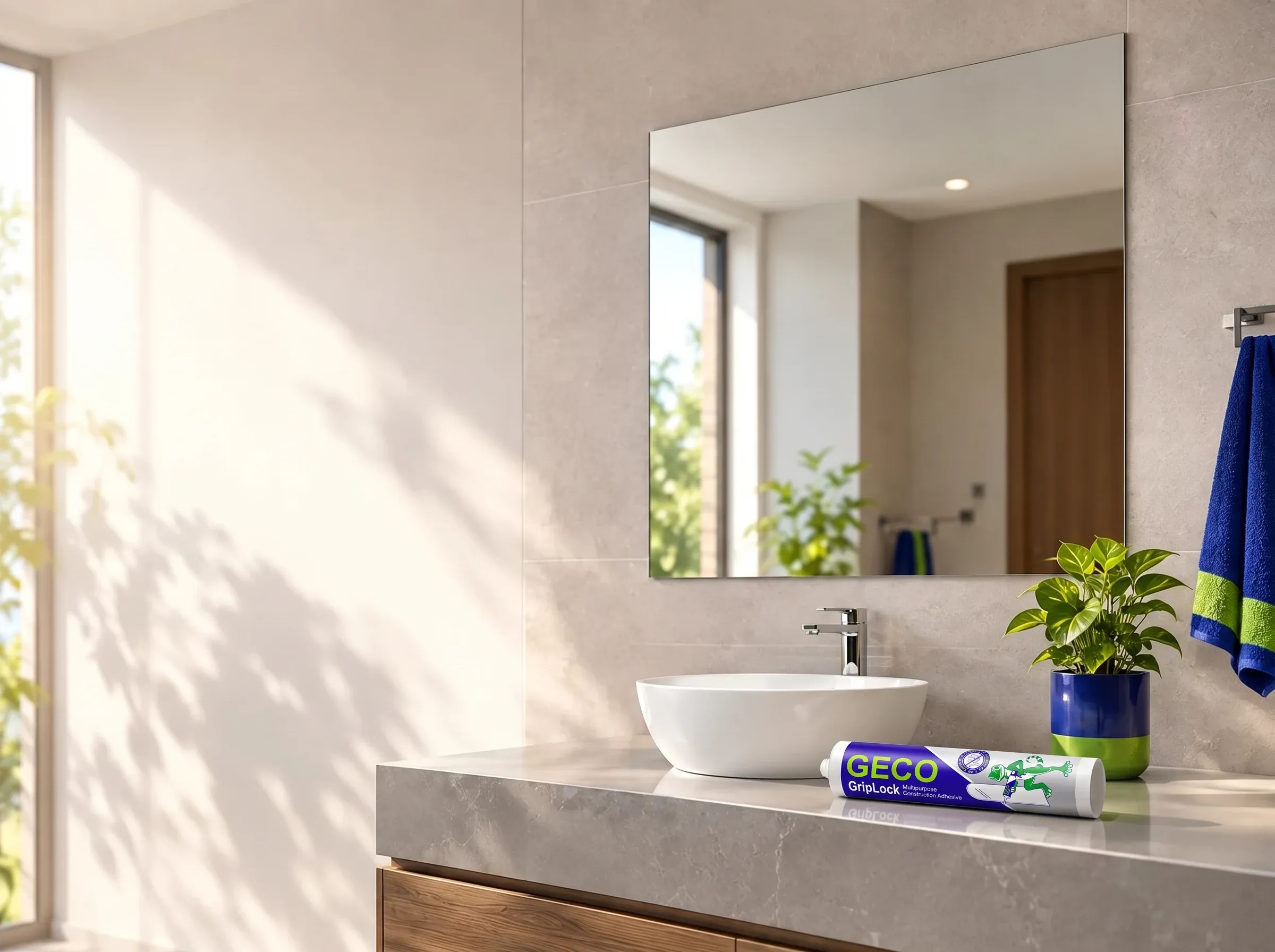
Best Construction Adhesive for Home Repairs: What to Use for Wall-Mounting, Panels, and Fixtures
12 October 2026Some of the best home repairs leave no trace: no drilled holes, no dust, no cracked tile. The mirror, panel, or shelf simply stays exactly where you put it.
Whether you’re a contractor fitting wall cladding or a homeowner hanging a mirror over the vanity, the adhesive you choose decides how strong, clean, and long-lasting the result will be. Geco GripLock is built for exactly this kind of work. It’s a high-grab construction adhesive that takes hold the moment two surfaces meet and stays permanently elastic on tile, stone, glass, metal, timber, and more.
What Is Construction Adhesive?
Construction adhesive is a high-performance bonding product that joins building and finishing materials without relying on nails, screws, or other mechanical fasteners. Ordinary household glue is made for light materials. Construction adhesive is made to bond tile, stone, glass, metal, timber, plywood, aluminium composite panels (ACP), and concrete.
Most construction adhesives come ready to use in cartridges that fit a standard caulking gun. That makes them easy enough for a careful DIYer and dependable enough for professional installers. The right choice depends on what you’re bonding, how heavy it is, the condition of the surface, where it’s going, and how much movement it will see.
Movement matters more than most people expect. Materials expand and contract at different rates. A rigid adhesive can crack under that shift, but an elastic one flexes with it and keeps holding. That’s why MS polymer adhesives have become a go-to choice: they combine strong adhesion with flexibility and weather resistance.
Why Geco GripLock Works for Home Repairs
A gecko holds fast to glass, stone, and bark without a single nail. GripLock brings the same idea to your home: dependable grip across a wide range of surfaces, with no drilling required.
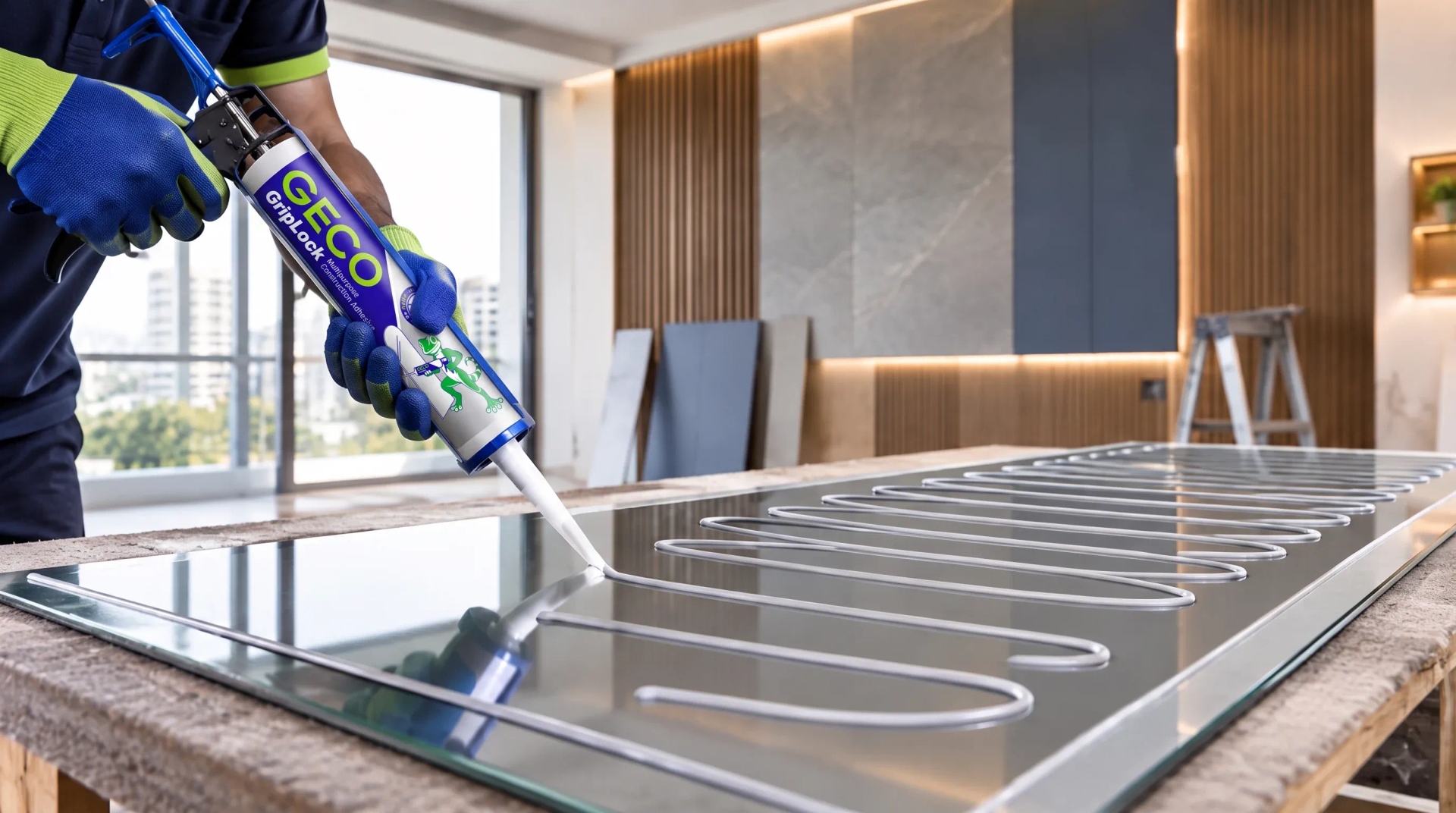
Geco GripLock is a one-part, high-grab construction adhesive-sealant based on MS polymer technology. It cures on contact with moisture in the air to form a tough, permanently elastic bond. It does the work of nails, screws, clamps, and double-sided tape, and it’s cleaner and faster.
What makes it right for home repairs:
- Strong grab: Takes hold the moment surfaces meet, so materials stay put while you work.
- Permanently elastic: Flexes with movement, vibration, and thermal shift. It stretches more than 375% before breaking and recovers more than 75% of its shape.
- UV and weather resistant: Performs indoors and outdoors.
- Non-sag, non-slump: Holds its bead on vertical surfaces without sagging or shrinking.
- Non-corrosive: Safe to use on metal surfaces.
- Non-staining: Leaves no marks on adjoining decorative surfaces.
- Paintable: Paint over it once it has cured to match the surrounding finish.
- Cleaner to work with: Low odour, solvent-free, and isocyanate-free.
Best Adhesive for Wall-Mounting
Wall-mounting covers a lot of ground: mirrors, decorative panels, light shelves, frames, profiles, and back-painted glass. Drilling isn’t always the right choice, especially into finished tile, polished stone, painted walls, or walls that hide electrical and plumbing lines.
GripLock is made for:
- Fixing mirrors and painted or back-painted glass to tile, plywood, fibre cement, and board.
- Bonding wall cladding such as ACP, plywood, and laminate composites.
- Attaching profiles and panels to timber frames, aluminium channels, or walls.
- Bonding decorative elements where nails, screws, or double-sided tape won’t do the job.
Start with a sound wall. Remove loose paint, powdery plaster, dust, grease, and oil. Lightly sand glossy surfaces to a dull finish so the adhesive has something to grip.
For valuable, heavy, or safety-critical items, pair GripLock with brackets, props, or mechanical fixings. They keep everything steady while the adhesive cures and help carry the load over the long term.
Using Adhesive for Wall Panels
Wall panels come in ACP, plywood, laminate composites, fibre cement, timber, and more. They’re used for feature walls, partitions, decorative finishes, and protective surfaces.
GripLock bonds ACP, plywood, and laminate composite cladding to aluminium channels, timber frames, or walls. It also forms elastic bonds between panels, profiles, and frames.
For a clean panel installation:
- Measure and pre-fit: Check alignment, edges, joints, and cut-outs before any adhesive goes on.
- Prepare both surfaces: Make sure the wall and the back of the panel are clean, dry, and free of dust and grease.
- Apply the right bead pattern: Lay the adhesive in a zig-zag or in dots about 25 mm (1 inch) apart.
- Keep an edge margin: On large panels, stay about 35 mm in from every edge to control squeeze-out.
- Press into place: Apply firm, even pressure within the open time.
- Support heavy panels: Use temporary props or brackets and let the adhesive cure before the panel takes any load.
Keep the bead within its rated size rather than spreading one thick, continuous layer. Follow the panel manufacturer’s recommendations alongside ours. Large panels, uneven substrates (the surfaces you’re bonding to), and heavy cladding may need a designed fixing system or extra mechanical support.
Fixing Tiles, Stone, and Countertop Materials
Construction adhesive works well for bonding selected tiles, marble, granite, and stone slabs to compatible surfaces. GripLock fixes tiles, marble, and granite to plywood, concrete, and other substrates. It also mounts stone slabs for countertops, vanities, and tabletops.
Give it a base that is stable, clean, dry, and strong enough to carry the weight. GripLock is a bonding adhesive, not a levelling compound, so correct any major unevenness first and keep the bonding bead no wider than 10 mm.
Strong initial grab stops heavy stone from sliding, but the full cure is what carries the load. Support large or heavy pieces while they cure, and wait the full seven days before putting them to heavy use.
Mounting Fixtures Without Drilling
Trim, profiles, decorative frames, backsplashes, small ledges, and non-structural accessories are all good candidates for adhesive mounting. This is especially true where a drill could crack tile, chip polished stone, or pierce a waterproofing layer.
GripLock’s non-sag body stays in place on vertical surfaces, and its strong grab prevents slipping. Its non-corrosive, non-staining formula is gentle on metal profiles, glass, stone, and decorative finishes.
Know where adhesive ends and hardware begin. Grab bars, load-bearing shelves, heavy overhead fixtures, and anything under constant force need mechanical fixings designed for the load.
How to Apply Geco GripLock
Good preparation is what makes a strong bond. Here’s how to get it right:
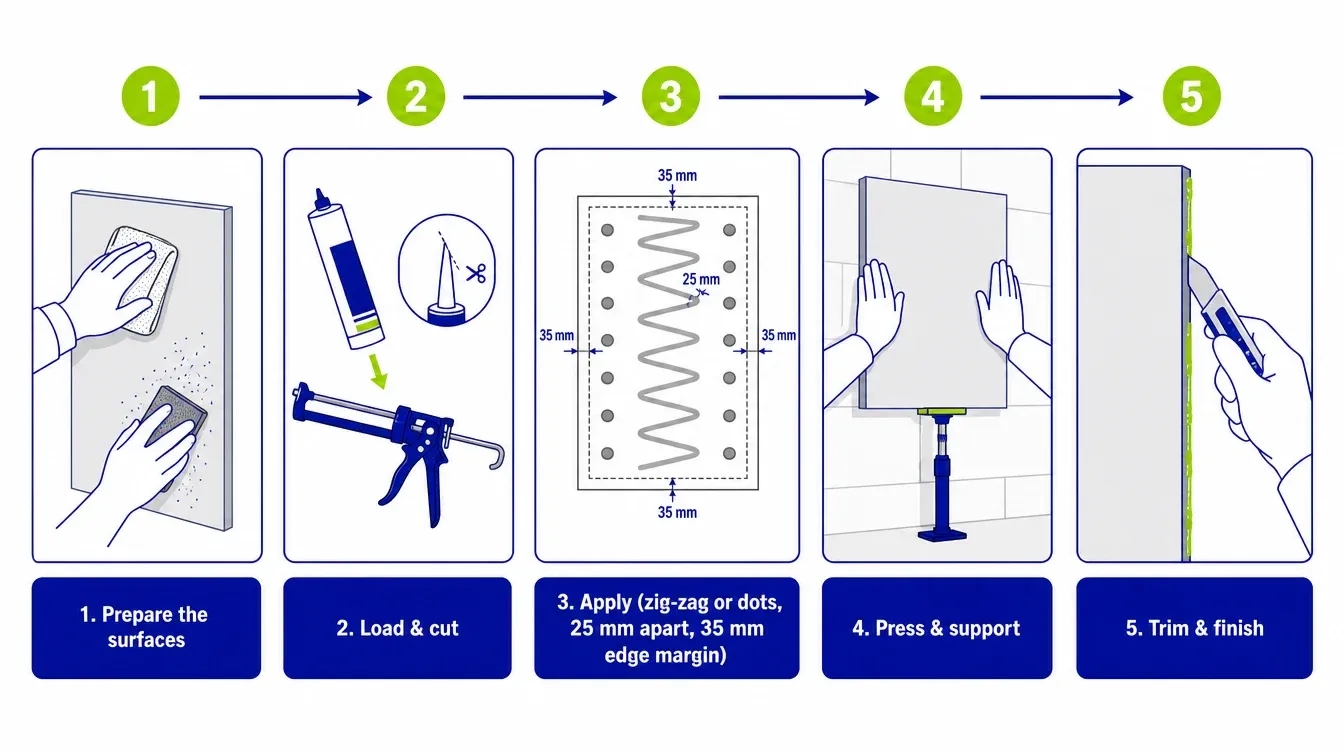
- Prepare the surfaces: Both surfaces should be clean, dry, and free of dust, grease, oil, and loose particles. For the best cure, at least one surface should be non-glossy, so lightly sand glossy surfaces to a dull finish and wipe away the dust. When bonding unfamiliar materials, always do a small trial first.
- Load the cartridge: Insert the cartridge into a caulking gun and cut the nozzle to the bead size you need. Use a smaller bead for light work and a wider one for larger surfaces, within the 2 mm to 10 mm bonding range.
- Apply the adhesive: Lay the adhesive on one surface in a zig-zag or in dots about 25 mm (1 inch) apart. Keep the bead lean, because an oversized bead only adds squeeze-out and cure time. On large panels, keep a 35 mm margin from the edges.
- Join and support: Press the surfaces together firmly while the adhesive is still open. GripLock forms a skin in about 5 minutes and is tack-free in about 10 minutes at 23°C and 50% relative humidity, so work in manageable sections. Prop or bracket heavy glass, stone, and shelves until the adhesive has cured, and wait before applying full loads.
- Clean and finish: Wipe away uncured adhesive before it sets. Once cured, trim it neatly with a sharp blade and paint over it to match the finish. Check paint compatibility first.
Where GripLock Isn’t the Right Fit
GripLock is not recommended for:
- Polyethylene (PE), polypropylene (PP), PTFE, silicone rubber, or bituminous surfaces.
- Permanent water immersion or submersion.
- High-temperature or gasketing applications.
- Filling gaps wider than the rated bead.
Product data is a general guide. Run a trial before full-scale use, especially for high-value, large, heavy, or unusual installations.
Final Selection Checklist
Before choosing a construction adhesive for a home repair, ask:
- What materials are being bonded?
- Is the application indoors or outdoors?
- Will the surfaces face vibration, thermal movement, or moisture?
- Does the item need strong initial grab?
- Will the adhesive be visible, or will it need painting?
- Is temporary support or a mechanical fixing required?
- Can the surfaces be cleaned and prepared properly?
- Is the application listed on the product’s data sheet?
The Right Grip for Every Repair
For wall-mounting, panels, mirrors, cladding, tile, stone, and everyday fixtures, Geco GripLock is a cleaner alternative to drilling and fastening. It gives you strong grab, non-sag application, permanent elasticity, weather resistance, and multi-surface bonding in one cartridge. GripLock becomes the invisible foundation of what you build, so you can simply enjoy the result.